


Our Cardiology Team
Dr. Amanda Lawler, Residency-Trained Cardiologist
Cardiology services at Hudson Highlands Veterinary Medical Group are provided by Dr. Amanda Lawler, a residency-trained veterinary cardiologist on our in-house team. Dr. Lawler has the specialized skills and experience to evaluate and manage a wide range of cardiac conditions in dogs and cats — right here at our Hopewell Junction facility.
Her approach centers on giving you a clear picture of what's happening with your pet's heart and a practical plan for managing it, while keeping your family vet fully in the loop. Whether your pet has been living with a known heart condition or a concern has just been identified, Dr. Lawler provides the specialist-level evaluation your pet needs, close to home.
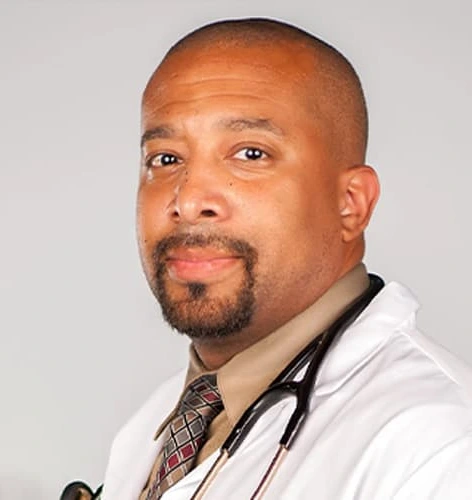
Dr. Jonathan Goodwin, DVM, MS, DACVIM (Cardiology)
Jonathan Goodwin, DVM, MS, DACVIM (Cardiology), is board certified in veterinary cardiology. He received his veterinary degree from Tuskegee University School of Veterinary Medicine. He completed his internship in 2000 with an emphasis on internal medicine and cardiology, then earned a master’s degree in cardiovascular physiology and completed a cardiology residency at Purdue University. He achieved board certification in 2008. Dr. Goodwin has led his own specialty practice and worked within large specialty hospitals. He has also served in leadership roles, including medical director and consultant to veterinary medical companies.
View all specialty services
Cardiac Conditions We Treat
Veterinary cardiology is the branch of medicine focused on diagnosing and managing diseases of the heart and cardiovascular system in animals. Just like in people, pets can develop a wide range of heart conditions, some they’re born with, and some that develop over time. A veterinary cardiologist has advanced training specifically in how the heart functions, what can go wrong, and how to manage those problems in a way that protects your pet’s quality of life for as long as possible.
Heart Murmurs in Dogs & Cats
A heart murmur is an abnormal sound caused by turbulent blood flow within the heart. Murmurs are graded on a scale from I to VI based on their intensity, but grade alone doesn’t tell the full story, some low-grade murmurs are clinically insignificant, while others indicate underlying structural disease that needs to be monitored or treated.
An echocardiogram (cardiac ultrasound) is the most reliable way to determine what’s causing a murmur and how significant it is. Dr. Lawler and Dr. Goodwin evaluate murmurs in both dogs and cats, determine whether intervention is warranted, and establish a monitoring plan appropriate for your pet’s specific situation.
Congestive Heart Failure
Congestive heart failure (CHF) occurs when the heart is no longer able to pump blood effectively, causing fluid to accumulate in the lungs or abdomen. Signs can include coughing, labored breathing, reduced exercise tolerance, and a distended belly. CHF is a serious condition, but with proper management, many pets live comfortably for months to years after diagnosis. Treatment typically involves medications to reduce fluid buildup and support heart function, along with dietary modifications and regular monitoring.
Dilated Cardiomyopathy (DCM)
Dilated cardiomyopathy (DCM) is a condition in which the heart muscle weakens and the chambers of the heart enlarge, reducing the heart’s ability to pump blood efficiently. It is seen most commonly in large and giant breed dogs, including Doberman Pinschers, Great Danes, Irish Wolfhounds, and Boxers, though it can occur in other breeds as well.
DCM can progress silently before outward signs appear, making echocardiographic screening important for high-risk breeds. When identified early, medical management can help slow progression and delay the onset of heart failure symptoms.
Mitral Valve Disease
Mitral valve disease (MVD) is the most common acquired heart disease in dogs, and it is particularly prevalent in small breeds such as Cavalier King Charles Spaniels, Dachshunds, and Poodles. The mitral valve, which separates the left atrium and left ventricle, gradually degenerates and begins to leak — a condition called mitral valve regurgitation.
MVD progresses slowly in many dogs and may not require treatment for years. However, as the disease advances, it can lead to congestive heart failure. Research has shown that certain medications, started at the right stage, can delay the onset of heart failure in dogs with MVD.
Arrhythmias & Rhythm Disorders
Arrhythmias are abnormalities in the electrical activity of the heart that cause it to beat too fast, too slow, or irregularly. Some arrhythmias are benign and require no treatment, while others can cause fainting, weakness, or collapse.
Common arrhythmias seen in dogs and cats include atrial fibrillation, ventricular tachycardia, sick sinus syndrome, and atrioventricular (AV) block. Diagnosis relies on electrocardiography (ECG) and sometimes Holter monitoring, which records the heart’s rhythm over 24 hours to capture intermittent abnormalities.
Congenital Heart Defects
Congenital heart defects are structural abnormalities that are present from birth. Some breeds are more prone to specific congenital defects than others. In many cases, these conditions are identified early in life during a routine exam. In others, they may not cause noticeable symptoms until the pet is older.
Common congenital conditions include pulmonic stenosis, subaortic stenosis, and patent ductus arteriosus (PDA). Depending on the severity, some congenital defects can be managed medically, while others may be candidates for interventional procedures.
Cardiac Diagnostics & Procedures
Accurate diagnosis is the foundation of good cardiac care. We use a combination of advanced imaging and monitoring tools to assess your pet’s heart function, identify the nature and severity of any condition, and guide treatment decisions.
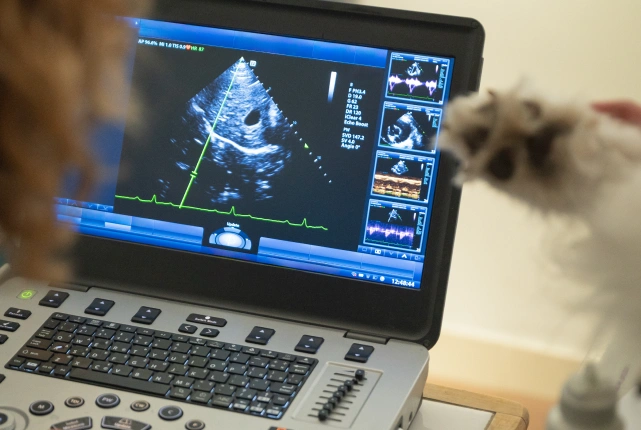

Echocardiography (Cardiac Ultrasound)
An echocardiogram is an ultrasound of the heart that allows the cardiologist to visualize the heart’s structure and function in real time. It provides detailed information about the size of the heart chambers, the thickness of the heart walls, how well the valves are opening and closing, and how effectively the heart is pumping blood.
Echocardiography is non-invasive, requires no sedation in most patients, and is considered the gold standard for diagnosing and staging most cardiac conditions in dogs and cats. It is essential for evaluating murmurs, monitoring disease progression, and guiding treatment timing.
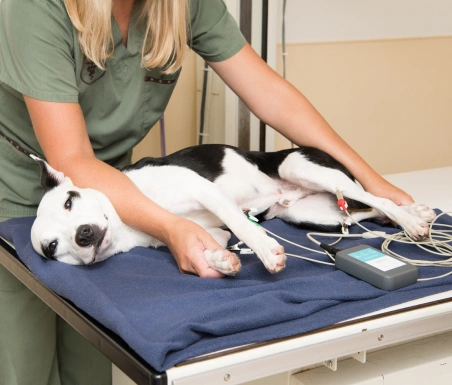
Electrocardiography (ECG/EKG)
An electrocardiogram (ECG or EKG) records the electrical activity of the heart and is the primary tool for diagnosing arrhythmias. It can identify abnormal rhythms, conduction disturbances, and other electrical irregularities that may not be apparent on physical examination alone.
ECGs are fast, non-invasive, and can be performed without sedation in most cooperative patients. They are often used alongside echocardiography for a complete cardiac evaluation.
Holter Monitoring
A Holter monitor is a wearable device that continuously records your pet’s heart rhythm over a 24-hour period. It is particularly useful for detecting intermittent arrhythmias that may not be present during a brief in-clinic ECG. Holter monitoring is commonly used in breeds at high risk for arrhythmias — such as Doberman Pinschers and Boxers — and in pets with unexplained episodes of weakness, collapse, or fainting.
The monitor is placed on your pet in the clinic and worn at home during normal daily activity. The recorded data is then analyzed by Dr. Lawler or Dr. Goodwin to identify any rhythm abnormalities and determine whether treatment is needed.
For Referring Veterinarians
Hudson Highlands Veterinary Medical Group welcomes cardiology referrals from veterinary practices throughout the region. We understand that your clients and their pets rely on you, and our goal is to provide seamless specialist care that keeps you fully informed.
After each consultation, a detailed report of findings and recommendations is sent directly to your practice. Your client's primary care relationship remains with you — Dr. Lawler or Dr. Goodwin handles specialist-level cardiac evaluation and ongoing management as needed, coordinating closely with your team throughout.
Cardiology appointments are scheduled by appointment only. To refer a patient, please call us.
Referral Coordinator
Frequently Asked Questions About Pet Heart Disease
My dog was diagnosed with a heart murmur — do I need a cardiologist?
What does an echocardiogram show for a dog or cat?
What breeds are most prone to heart disease?
Does my pet need a referral to see a veterinary cardiologist?
Related Services
Orthopedic Surgery
Performed by Dr. Paul McNamara, our in-house veterinary surgeon, orthopedic surgery at Hudson Highlands covers bone, joint, and musculoskeletal conditions in dogs and cats. Procedures include TPLO for torn cruciate ligaments, fracture repair, patella luxation surgery, femoral head osteotomy (FHO), and treatment of growth abnormalities. Dr. McNamara and his surgical technicians are also certified in the PennHIP technique for measuring canine hip joint laxity, used to screen dogs for hip dysplasia and assess breeding candidates.
Learn More
Internal Medicine
Our internal medicine service provides specialist-level diagnosis and treatment for complex conditions affecting the internal organ systems — including metabolic disease, endocrine disorders, immune-mediated blood disease, gastrointestinal conditions, liver and kidney disease, infectious disease, and fever of unknown origin. Outpatient diagnostics, including high-resolution ultrasonography with guided aspirates, are available at our main facility with board-certified specialist Dr. John Broussard.
Learn More